















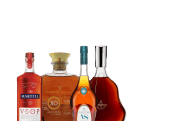


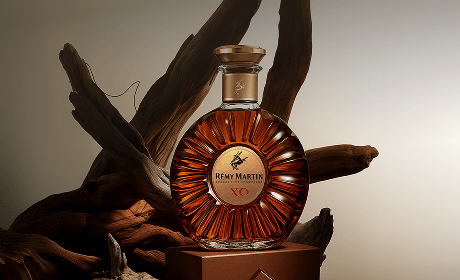
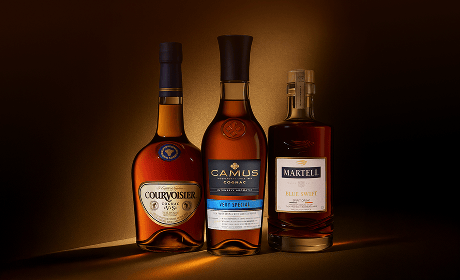













Cognac is one of the oldest and most tightly regulated distilled spirits in the world — yet most buyers can name only four houses. Hennessy, Rémy Martin, Martell, and Courvoisier together control over 80 % of global sales. So what cognac should you buy instead of another duty-free bottle? The rest of the market — family estates rooted in Grande Champagne, single-vintage millésime bottlings from specific harvest years, hand-numbered limited editions from houses like Frapin, Hine, Tesseron, and Delamain — reaches only a narrow circle of insiders.
The European cognac market is maturing. More and more buyers are moving away from mass-market whisky and premium vodka toward bottles with provenance and terroir identity — a visible trend at finespirits.pl, where demand for aged, terroir-specific spirits is growing faster than demand for volume brands. Premium cognac is no longer a niche for the few — it is becoming a deliberate choice for collectors and connoisseurs.
For the informed collector, this is a window of opportunity before the broader market catches on. These bottles are limited by nature: small estates, reserves built over decades, ageing rules that cannot be accelerated. This article covers the cru system explained, the definition of millésime, five cognac brands from the Fine Spirits range, and concrete buying recommendations — the best cognac to buy in 2026 for three different buyer profiles.
What Is a Cru in Cognac — A Clear Definition
The word cru in cognac does not mean the same thing as in Bordeaux. In Bordeaux, a cru is a classified estate — a specific château with a formally assigned rank. Cognac has no classified châteaux. Here, cru denotes an official vine-growing zone with a defined soil type and climate: a demarcated geographical area whose soil composition and microclimate determine the character of the eau-de-vie produced within it.
The analogy for anyone familiar with Burgundy is straightforward: a cru in cognac works like an appellation — a specific piece of land with a specific soil that leaves its mark on the spirit. Gevrey-Chambertin is what it is because the vines grow where they grow — not because someone decreed it. The same mechanism applies in cognac. Geography is destiny.
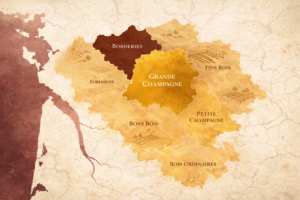
The Six Cognac Crus — Hierarchy from Highest to Lowest
| Cru | Characteristics | Significance for collectors |
|---|---|---|
| Grande Champagne | Highest chalk content, the most refined and longest-maturing eaux-de-vie | Highest collectability |
| Petite Champagne | High chalk content, similar style, slightly faster aromatic expression | Excellent quality-to-price ratio |
| Borderies | Small zone, rounded style, distinctive nutty and violet notes | Unique profile, prized by connoisseurs |
| Fins Bois | Largest growing zone, fruitier and faster-maturing character | Good entry point |
| Bons Bois | Lighter soils, less finesse, used mainly in blends | Rarely stated on labels |
| Bois Ordinaires | Outermost zone, least frequently stated on labels | Marginal significance |
Chalk determines everything. The more chalk in the soil, the more delicate the eau-de-vie — and the more time it needs in barrel before it speaks at full volume. That is why Grande Champagne produces the most collectible, longest-lived cognacs, and why houses rooted in that zone attract the greatest collector interest. The difference between crus is practical, not ceremonial: a bottle stating its cru carries a geographical signature that a multi-vintage blend, by definition, cannot.
Grande Champagne — The Pinnacle of the Cognac Cru Hierarchy
Grande Champagne is cognac’s premier cru — the reference zone, the first place a serious collector looks. Its chalk-limestone soils produce eaux-de-vie that start lean, almost austere, with a tightly wound structure. Patience is the only thing that opens them. After 15, 20, 30 years in oak, they develop extraordinary complexity: floral top notes, subtle saline minerality, dried-fruit depth, and a finish that refuses to let go. The principal communes of the zone are Cognac and Ségonzac.
Chalk does two things at once. It drains water efficiently, stressing the vine and concentrating flavour. It also provides a mineral skeleton that translates directly into eau-de-vie with refined texture and the potential for extended ageing. Other crus produce excellent spirits — Borderies has a distinct personality — but none ages over decades with the same trajectory as Grande Champagne.
Houses like Frapin, Delamain, and Hine build their identities on Grande Champagne fruit. The cognac brands available at finespirits.pl — Lheraud, Dupuy, Gautier, and Pierre Vallet — all carry bottles sourced from Grande or Petite Champagne in their portfolios, making them particularly compelling for collectors seeking terroir purity. A bottle stating Grande Champagne provenance from a serious producer offers something that large blending operations structurally cannot: a single geographical fingerprint, undiluted.
Niche Cognac Brands 2026 — What Cognac to Buy Beyond Hennessy
The houses below do not appear on airport duty-free shelves. They have not yet become mainstream favourites — and that is precisely why they are worth knowing now. Each cognac brand has a specific argument: terroir discipline, cellar heritage built over generations, single-vintage releases from individual harvests, or full producer control from vineyard to bottle. All five are available at finespirits.pl today, at prices that still reflect their relative obscurity rather than their actual quality.
What cognac to buy in 2026 instead of yet another big-brand XO? Below — five specific answers.
Comparing 5 Niche Cognac Brands — Overview
| Brand | Cru | Style | Distinguishing feature | Best for |
|---|---|---|---|---|
| Lheraud | Fins Bois, Grande Champagne | Vintage, artisanal | Millésime from specific years | Collectors seeking vintages |
| Dupuy | Grande Champagne, Fins Bois | Chai Paradis, numbered lots | Hand-drawn from individual casks | Collectors, long-term holdings |
| Gautier | Grande Ch., Petite Ch., Fins Bois | Riverside cellar, rich | Ageing above the River Osme since the 18th c. | History and terroir enthusiasts |
| Pierre Vallet | Grande Ch., Petite Champagne | Grower-producer, pure | Full chain control, 125+ ha | Purists seeking quality at a fair price |
| Meukow | Grande Ch., Petite Ch. (higher cuvées) | Design-forward, approachable | Panther bottle, Black Panther editions | Newcomers to cognac, gift buyers |
Lheraud — Artisanal Cognac with Single-Vintage Bottlings
Lheraud is a family-owned cognac house with roots in the 19th century — stubbornly traditional in everything: viticulture,
distillation, and the pace of ageing.
The family works with vineyards in Fins Bois and Grande Champagne, harvests by hand, distils in Charentais copper pot stills, and ages in stone cellars with no pressure for rapid turnover.
The house’s speciality is the millésime — single-vintage cognac bottlings from specific years: 1972, 1975, 1978, bottled as one-harvest time capsules. One vineyard, one vintage, one maturation curve in a sealed cask. A standard blend averages across years to hit a set profile; a Lheraud millésime records precisely what one particular season gave. This is vintage cognac in its purest form.
Which Lheraud cognac to buy first:
- Lheraud XO — the entry point into artisanal cognac. An age-stated blend that punches well above its price. A strong choice if you are looking for premium cognac from a niche house at an accessible price point.
- Lheraud Millésime — a collector’s move: sealed provenance that cannot be reproduced once the run sells out.
Dupuy — A Historic House from Jarnac with Chai Paradis Reserves
Auguste Dupuy founded the house in Jarnac in 1852. The Bache-Gabrielsen family runs it today. What defines Dupuy’s identity is how its eaux-de-vie are sourced and matured: top crus including Grande Champagne and Fins Bois, held for decades in a dedicated cellar before bottling — with a contemporary presentation that accompanies genuinely old reserves.
That cellar is the Chai Paradis — where the oldest and most precious eaux-de-vie rest for decades, forming the backbone of prestige blends and limited editions. The Prestige Collection and Rare Réserve Collection are that work in tangible form: individually numbered lots (Lot 70, 73, 75, 78), hand-drawn from single casks. When a cask is empty, it is gone. No topping up, no re-blending to recreate last year’s profile.
Which Dupuy cognac to buy first:
- Dupuy VSOP or XO — a sensible first move. A clear quality step up from mass-market brands at a still-reasonable price.
- Dupuy XXO Prestige or a Rare Réserve lot — cognac for the serious collector. Every lot currently available at finespirits.pl deserves attention before the wider market notices.
Gautier — Cognac from a Riverside Cellar with the Deepest History in This Guide
The origins of Gautier date back to the mid-17th century. Louis XV granted the house a royal charter in 1755. But the physical detail that truly shapes these cognacs is architectural: Gautier’s cellars occupy a former watermill on the River Osme in Aigre. The natural humidity of this riverside environment slows evaporation,softens tannins, and builds a richness in
 the maturing spirit that dry, inland cellars simply do not produce.
The house blends eaux-de-vie from Grande Champagne, Petite Champagne, and Fins Bois into assemblages that emphasise richness, balance, and length. Its Paradis cellar holds reserves stretching back to the 19th century — documented bottles from 1840 and a cognac from 1762, recognised by Guinness as one of the oldest ever sold at auction. That bottle was purchased by a Polish company — a telling sign of the appetite for historic spirits in Eastern Europe.
Which Gautier cognac to buy first:
- Gautier VSOP — an underappreciated premium cognac. The heritage of a riverside cellar at an accessible price.
- Gautier XO — for the buyer who wants genuine heritage at a price that has not yet caught up with the history. One of the most compelling bottles at finespirits.pl.
- Gautier special cuvée — cognac instead of Hennessy XO, with provenance that a mass-market brand cannot offer.
Gautier vs Hennessy — which to choose? They serve different purposes. Hennessy is scale and consistency. Gautier is terroir character and documented heritage at a comparable or lower price. For the buyer looking for the best cognac in its price class — Gautier makes the stronger argument.
Pierre Vallet — Cognac from a Grower-Producer at Château Montifaud
-
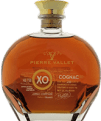
Pierre Vallet is the cognac brand of the Vallet family — six generations, over 125 hectares of vines in Grande and Petite Champagne under the Château Montifaud estate. The family controls the entire chain: chalk-limestone soils, double distillation in copper pot stills, oak-barrel ageing, and the decision of when to bottle. No external purchases of eaux-de-vie,
 no shortcuts in the production chain. This is a grower-producer cognac — the equivalent of a récoltant-manipulant in Champagne.
The style rests on ageing that exceeds the legal minimum:
- Pierre Vallet VS — even at entry level, fresh, floral, and fruity, with more complexity than the category typically offers.
- Pierre Vallet VSOP — adds time: more spice, more texture. A good alternative to whisky for anyone exploring new flavours.
- Pierre Vallet XO — the youngest component is around 20 years old. Dried fruit, layered spice, and a finish that lingers.
In terms of quality-to-price, Pierre Vallet XO at finespirits.pl is hard to argue against. This is a grower-producer who approaches cognac the way the finest Burgundy domaines approach wine — full responsibility for the entire chain, no compromises. If you are looking for the best cognac to buy in 2026 at a fair price, start here.
Meukow — Cognac in a Panther Bottle with Champagne-Cru Content
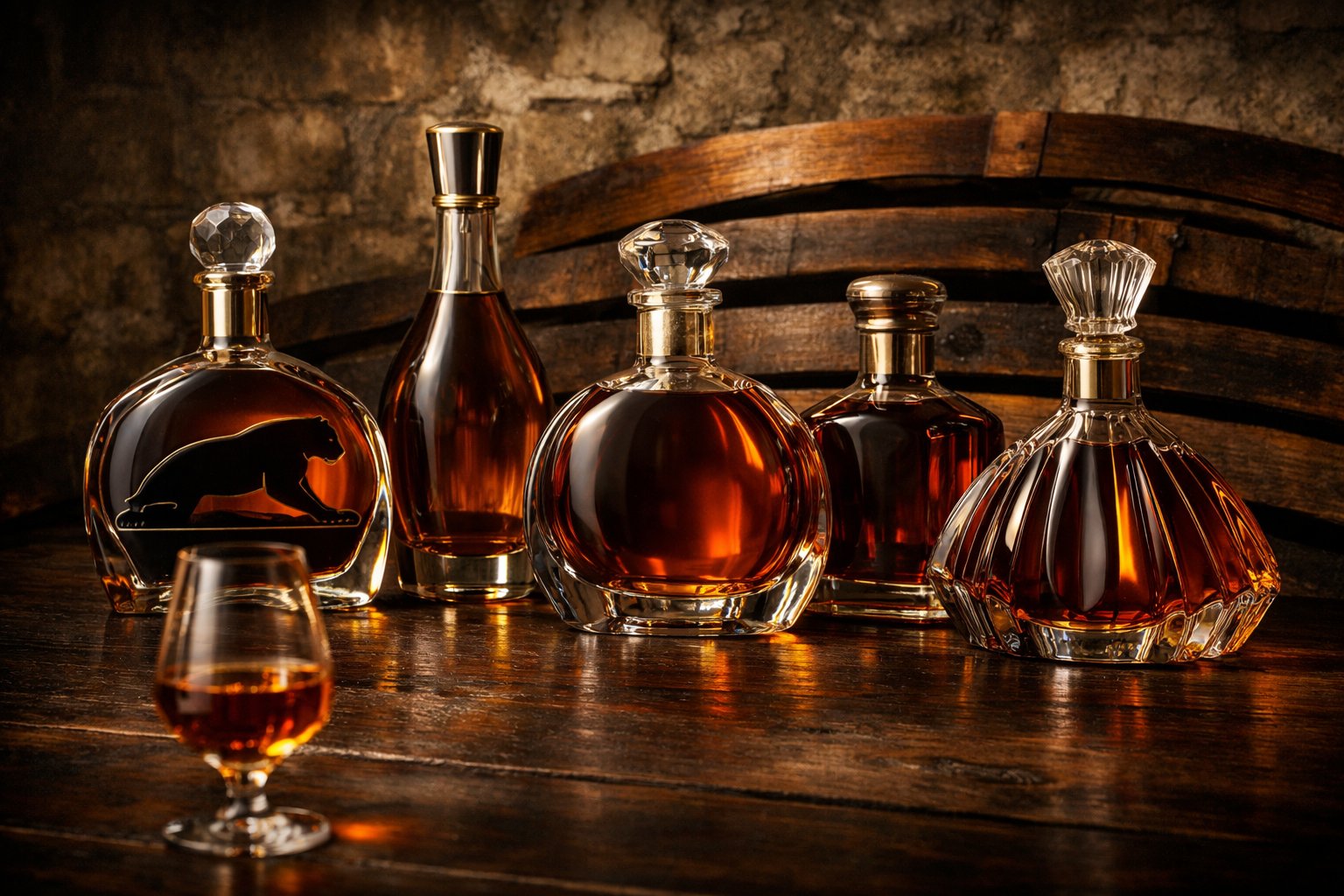
Brothers Gustav and August-Christophe Meukow founded the house in 1862, originally supplying cognac to the court of the Russian Tsar. The house has passed through several chapters and emerged as something hard to categorise: the félin panther bottle, introduced in the 1990s, earned cult status among design-conscious connoisseurs — yet Meukow remains niche enough to feel like a discovery rather than a logo purchase.
The blends draw eaux-de-vie from multiple crus, with a significant proportion of Grande and Petite Champagne in the higher cuvées — resulting in a supple, medium-bodied style with real backbone.
Cognac vs whisky — Meukow as a bridge: the profile of Meukow VSOP reads like familiar territory for whisky palates — caramel, dried apricot, vanilla, and spice, warm and approachable. Recognisable oak and sweetness notes, but with a floral character and Champagne-cru structure underneath. If you are looking for cognac instead of whisky for an evening pour, this is a natural starting point.
Which Meukow cognac to buy:
- Meukow VSOP — the ideal first cognac for a whisky or bourbon lover. Also an excellent gift — the panther bottle makes an impression without requiring explanation.
- Meukow Black Panther (limited edition) — design and Champagne-cru content in a single bottle, in production runs that do not sit on shelves forever. A collectible dimension.
Vintage Cognac (Millésime) — When a Single Year Tells the Whole Story
Why Vintage Cognac Is the Exception on the Market
Most cognac is a deliberate blend — and blending is a skill, not a shortcut. A house like Hennessy or Rémy Martin employs a maître de chai whose job is to marry eaux-de-vie from multiple vintages and multiple crus until the result hits the established house style. Their VS tastes the same year after year because that is the entire point.
Millésime works in reverse. It is eau-de-vie from a single harvest year and a single growing zone, sealed in a cask under the supervision of the BNIC (Bureau National Interprofessionnel du Cognac) — with no topping up and no blending of vintages. The result is rare by the very construction of its production, not because of a marketing decision. Those casks are occupied for decades to yield a small number of bottles.
The analogy is straightforward: vintage Champagne versus non-vintage brut. Both can be excellent. Only one of them has captured a specific year.
Blend vs Millésime — Key Differences
| Feature | Blend (standard) | Millésime (vintage) |
|---|---|---|
| Source | Multi-vintage, multi-zone | Single harvest year, single cru |
| Oversight | Producer’s standard | Cask under BNIC supervision |
| Availability | Continuous, replenished | Finite by definition |
| Style | Consistent house style | Imprint of a specific year |
| Collectability | Limited | High — cognac worth collecting |
Which Cru Performs Best in Long-Aged Vintage Cognac
| Cru | Maturation curve | Collectability |
|---|---|---|
| Grande Champagne | Longest — full expression after 30+ years | Highest |
| Petite Champagne | Faster expression, different profile | High, more accessible pricing |
| Fins Bois | Fastest expression | Good entry point into millésime |
The collectible character of vintage cognac rests on four factors: minimal production, decades of uninterrupted barrel ageing, clean provenance, and the history attached to the harvest year.
The 1914 vintage sits at the extreme intersection of all four. A pre-war cognac that has survived a century intact is a time capsule more than a spirit. Hine 1914 Grande Champagne commands secondary-market prices commensurate with that rarity.
The golden era of vintage cognac — roughly the 1920s through the 1960s — is widely regarded by auction specialists as the peak period. Growing conditions were historically favourable, and many casks rested for decades in cellars never hurried by the market. Post-war production from reputable, single-estate houses took place in volumes that seem minimal by today’s standards.
Bottles from 1962 and 1973, where well-preserved examples still exist, attract collector attention — both for their own merits and because they belong to the broader category of collectible cognacs that cannot be reproduced once they are gone.
How to Choose the Best Cognac to Buy in 2026 — Three Buyer Profiles
The global cognac and brandy market is projected to grow steadily through the 2030s — premiumisation and the influx of new collectors are tightening supply at the top end as demand rises. The European spirits market is on the same course: consumers are spending more on bottles with clear provenance instead of chasing volume. That is a direct tailwind for the independent houses described here. The best cognac in 2026 is not a question of brand prestige — it is a question of terroir and provenance.
Three practical profiles with concrete starting points:
Profile 1: Whisky Lover Looking for Cognac — Cognac Instead of Whisky
Cognac vs whisky is not a competition — it is a flavour-palette expansion. Start with a measure of Frapin 1270 or Delamain Pale & Dry at a bar to feel the Grande Champagne register — floral lift, minerality, dry finish.
Then your first bottle from finespirits.pl:
- Meukow VSOP or Pierre Vallet VSOP — for familiar oak structure
- Gautier XO — if history matters as much as what is in the glass
Profile 2: Collector Building a Cognac Section — Cognac for Collectors
A three-bottle strategy:
- A Grande Champagne XO as a benchmark — Frapin or Delamain as a reference point, Gautier XO or Pierre Vallet XO as a value play
- One millésime from Lheraud or Hine — a specific year, sealed provenance, finite quantity
- One “library bottle” for the long term — a Dupuy Rare Réserve lot, an older Tesseron or Pierre Ferrand release — something you can comfortably set aside for five to ten years
Profile 3: Cognac as a Serious Gift
- Dupuy XXO Prestige — provenance and Chai Paradis history
- Gautier XO — the house’s heritage as a backdrop, a bottle with history stretching back to the 18th century
- Meukow Black Panther — design plus substance in one, the ideal cognac gift that needs no explanation
Market context makes timing relevant. Spending on premium spirits in Europe is rising, and the bottles with the smallest production runs — Lheraud millésime, Dupuy lots, Gautier’s deeper reserves — will attract attention before their prices reflect it.
The Scarcity of Niche Cognacs — Why It Pays to Buy Now
The scarcity here is structural, not manufactured:
- Lheraud works with roughly 80–85 hectares across key crus; vintage releases come from single-year, sealed casks in stone cellars — with no way to scale production.
- Dupuy — Chai Paradis lots (Lot 70, 73, 75, 78) are hand-drawn from individual casks and numbered at bottling. When a cask is empty, that specific cognac is gone forever.
- Gautier — the Paradis cellar holds reserves older than the French Revolution. Those stocks cannot be replenished.
- Pierre Vallet sets aside a portion of each year’s distillation according to a family rule, deliberately keeping older cuvées in small quantities.
- Meukow — limited Black Panther editions sell to both lifestyle consumers and collectors. Allocations can thin quickly once a particular bottle gains visibility.
Europe adds its own pressure. There is an active community of rare-spirit enthusiasts across the continent, and the appetite for historic bottles is well documented: the Gautier cognac from 1762 — recognised by Guinness as one of the oldest ever sold at auction — was purchased by a Polish company. As more whisky and rum enthusiasts shift part of their budget toward cognac, the producers with the smallest output and the most specific terroir story will attract attention first.
The “Buy Before the Market Catches On” List — Best Cognac 2026
| Bottle | Why now | Link |
|---|---|---|
| Lheraud Cuvée 10 | Artisanal cognac aged 10 years, Petite Champagne, entry into a serious niche house | Buy at finespirits.pl |
| Dupuy VSOP | Historic Jarnac house, clear step up from mass-market VSOP, accessible price | Buy at finespirits.pl |
| Gautier VSOP | Riverside-cellar heritage since 1755, underpriced for its pedigree | Buy at finespirits.pl |
| Pierre Vallet XO | Grower-producer, 125+ ha, Grande Champagne, best quality-to-price in the guide | Buy at finespirits.pl |
| Meukow XO | Champagne-cru backbone, iconic panther bottle, 20 years aged | Buy at finespirits.pl |
Please drink responsibly. Sale of alcohol to persons under 18 is prohibited by law. Driving under the influence of alcohol is dangerous and illegal.
FAQ — Frequently Asked Questions About Niche Cognac Brands
What is a millésime — vintage cognac?
A millésime is a cognac from a single harvest year, bottled under BNIC supervision without blending with other vintages. Eau-de-vie from a single growing zone is sealed in a cask for decades and then bottled in a limited run tied to that specific cask. The rarity is a function of production mechanics, not marketing strategy — once a batch sells out, that vintage cannot be reproduced.
How does Grande Champagne differ from other cognac crus?
Grande Champagne has the highest chalk content of all six cognac growing zones. That chalk produces light, highly refined eaux-de-vie with a floral and subtly saline character. They develop slowly and require the longest ageing of any zone — which is why Grande Champagne bottles age best and are the most highly valued by collectors.
What cognac should I buy in 2026 instead of another big-brand XO?
Pierre Vallet / Château Montifaud XO — the best quality-to-price ratio among niche cognacs available today. A grower-producer style with full chain control from vineyard to bottle. Alternatively: Lheraud XO as an artisanal step up with vintage credibility, or Meukow VSOP for buyers who want Champagne-cru content and design appeal in one — without a premium for brand recognition.
How does Dupuy XXO or Rare Réserve compare with a standard big-brand XO?
XXO legally requires a minimum of 14 years of oak ageing — Dupuy’s Rare Réserve significantly exceeds that minimum. Components drawn from individually selected casks in the Chai Paradis deliver greater concentration, deeper complexity, and far smaller production volumes than mass-market XOs built on continuously replenished large reserves.
Is Meukow a good first cognac for a whisky lover?
Yes — Meukow VSOP is one of the best “starter” cognacs for whisky palates. The flavour profile — vanilla, caramel, toasted oak, a warm centre — reads as familiar territory. The backbone of Grande and Petite Champagne eaux-de-vie provides enough structure for the spirit to behave like a cognac, not a flavoured distillate. Cognac instead of whisky for an evening — a natural bridge between the two categories.
Gautier vs Hennessy — which cognac is better?
They serve different purposes, but Gautier offers stronger value for the discerning buyer. Hennessy is the world’s largest producer of blended cognac — consistency and scale are the product. Gautier is a historic house with riverside-cellar ageing since the 18th century and reserves from the 19th. For the buyer looking for the best premium cognac with terroir character and documented heritage at a comparable or lower price — Gautier XO makes the stronger argument.
Are Lheraud vintage cognacs harder to find than standard XOs?
Yes — because of production structure, not marketing. Lheraud millésime comes from a single harvest year and a single cru, ages in sealed casks for decades, and is then bottled in limited runs. Once a batch sells out, the house cannot reproduce that specific vintage. Standard XOs draw on continuously replenished reserves and remain available indefinitely.
Which brands at finespirits.pl focus on small batches and limited editions?
Dupuy and Lheraud — the clearest cases of collectible cognac. Dupuy’s individually numbered Chai Paradis lots and Lheraud’s single-vintage millésime bottlings are structurally limited by the size of specific casks. Worth remembering: no spirit is a guaranteed investment — choose bottles you would happily open, but that carry a logic for five or ten years from now as collector interest in niche cognac continues to grow.
What cognac makes a great gift in 2026?
Dupuy XXO Prestige or Gautier XO — a cognac gift that carries a story without requiring explanation. Provenance, a numbered bottle, and the heritage of the house do the work of a gift card. For a more design-forward approach: Meukow in the panther bottle — recognisable form, serious Champagne-cru content.